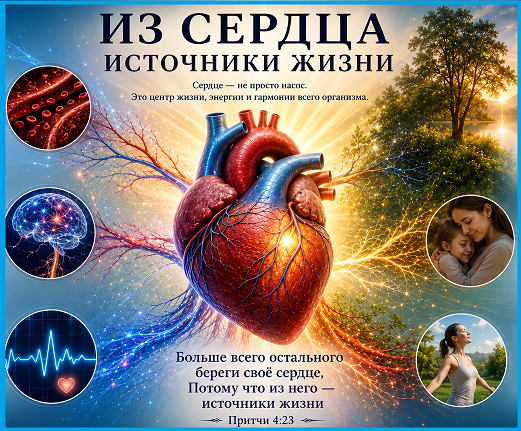
"From the heart springs life..."
"From the heart springs life..."
Proverbs 4:23
The concept
of "heart" is given enormous attention in Holy Scripture—it is
mentioned nearly a thousand times. In the vast majority of cases, ancient
authors used it symbolically, referring not simply to an organ but to "the
entire inner man." This term encompassed reason, will, deep emotional
motivations, memory, decision-making, and what we call intuition. For centuries,
the phrase from the Book of Proverbs, "Above all else, guard your heart,
for out of it spring the issues of life," was perceived solely as a
spiritual and philosophical metaphor.
However,
modern science proves that the biblical "symbolic heart" has a
clearly documented material basis. What the ancient prophets, under the
influence of God's spirit, described as a unified control center for the
individual is, in terms of advanced neurobiology and cardiology, called the
Neurovisceral Integration Model.
Cardioneuronal Interface: How the Heart Talks to the Brain
For a long
time, a bottom-up view of anatomy dominated medicine: the brain gave orders,
and the heart merely obediently pumped blood in accordance with those commands.
The development of neurocardiology has overturned this notion.
It turns out
that the heart has its own complex intrinsic cardiac nervous system, which
scientists have rightly dubbed a "little brain." This network,
consisting of tens of thousands of neurons, is capable of independently
processing information, adapting heart rate without involving the central
nervous system, and even possesses mechanisms for short-term and long-term
memory.
Moreover,
anatomical analysis revealed that the heart sends significantly more signals to
the brain via ascending (afferent) nerve fibers than it receives back. This
two-way communication channel—the cardioneuronal interface—continuously encodes
and transmits information about the body's internal state, forming the material
basis for the "heart's sense."
Anatomical outline of thoughts and emotions.
The link between our thoughts, feelings, and
physiological responses is the Central Autonomic Network (CAN). It unites brain
structures responsible for seemingly distinct processes:
- Regulation of emotions, fear, stress and
attachments (amygdala, insula);
- Higher executive cognitive functions, logic and
decision making (ventromedial prefrontal cortex, hippocampus).
The neurovisceral integration model, first formulated
by Professor Julian Thayer, postulates that executive cognitive functions and
emotional regulation are integrated with the heart into a seamless, functional
cognitive-autonomic circuit. When biblical texts assert that both thoughts and
impulses to action originate from the heart, they describe the functioning of
the CAN network with remarkable precision.
Mirror of the inner state.
The main
measurable indicator of the functioning of this complex circuit is heart rate
variability (HRV)—microscopic fluctuations in the intervals between heartbeats.
HRV reflects the tone of the vagus nerve and serves as a direct physiological
marker of a person's ability to self-regulate.
High heart rate variability
(Higher vagally-mediated HRV) directly correlates with:
- High quality working
memory and flexibility of thinking;
- Ability to cope effectively with stress;
- Successful control over destructive impulses.
If this autonomic indicator declines, a person becomes
cognitively rigid, losing emotional control and the ability to quickly adapt to
change. Thus, "sources of life" are a completely digitizable
psychovegetative resource.
From Theory to Practice: Digital Diagnostics of the "Inner
Person"
Until recently, comprehensive
assessment of neurovisceral integration required complex laboratory conditions:
fMRI to visualize the CAN network, electroencephalogram (EEG) recording to
record cardiac evoked potentials (HEPs), and exercise stress testing.
Today, the Language of the Heart Association
is developing applied tools that translate this fundamental knowledge into
practical analytics. By capturing the relationship between the central
nervous system, the heart, and autonomic regulation, scientists have succeeded
in creating complex analysis algorithms.
Through mathematical analysis of ECG, spectral
parameters of heart rate variability (PULF, ULFmx, VP parameters), and
multimodal behavioral analysis (including automated facial micromovement
recording with face-api and semantic speech analysis with Psycho_core), modern
diagnostics can provide insight into the personality. It allows for real-time
assessment of:
- Psychovegetative resource:balance of the nervous system (BNS), index of
activation of subcortical centers (IAP) and markers of exhaustion (MIE);
- Cognitive sphere:cognitive rigidity coefficient (CRC) and the
share of direct cortical control in decision-making (DCC);
- Cardiosomatic substrate:metabolic support of nervous activity and
hemodynamic efficiency (FAT).
Ancient inspiration from above
and scientific observations and research have converged on one point: our heart
is not just a pump, but a delicate biometric interface. And how effectively
this interface functions directly determines the quality of our decisions, the
depth of our relationships, and, ultimately, our very biological and mental
vitality.
Sources and research.
- Heart Rate Variability and Cognition: A Narrative
Systematic Review of Longitudinal Studies(MDPI, Clinical Medicine) - A systematic review
demonstrating the association between heart rate variability and executive
cognitive functions of the brain via the Central Autonomic Network (CAN).
- The connection between heart rate variability
(HRV), neurological health, and cognition: A literature review(Frontiers in Neuroscience) - A literature review
on the impact of HRV patterns on decision making, emotional regulation,
and cognitive health
- The intricate brain-heart connection: The
relationship between heart rate variability and cognitive functioning(PubMed / Neuroscience, 2025) - A study of the
interaction between cognitive and autonomic systems, showing how vagal
tone determines cognitive control.
- Heart-Brain Communication(HeartMath Institute) — Neurocardiology materials
detailing the four channels of communication between the heart and the
brain: neurological, biochemical, biophysical, and energetic.